As part of our commitment to accelerate research and awareness for ADLD, we need your help with an urgent initiative.
A Groundbreaking Natural History Study
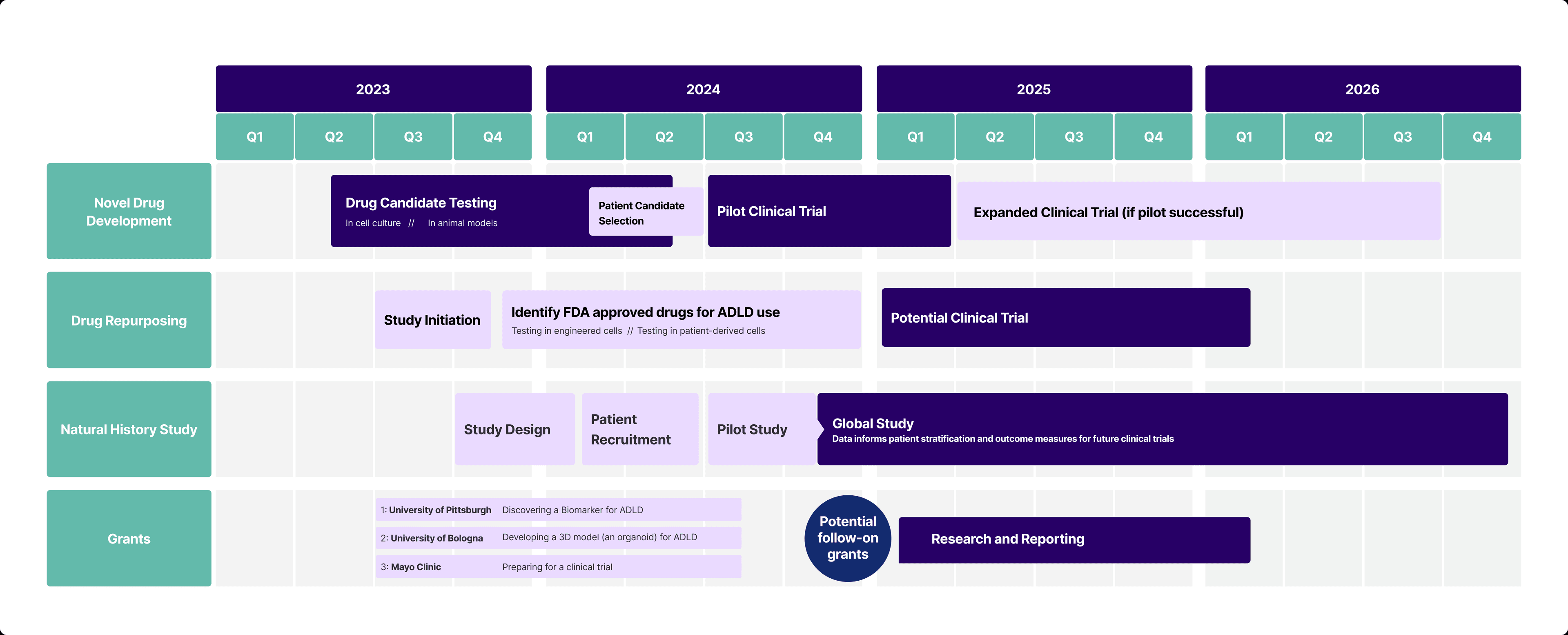
We are thrilled to announce a tentative collaboration with two leading national healthcare organizations to kickstart a Natural History Study (NHS) for ADLD. This study is a critical stepping stone to understanding the course of ADLD better and, ultimately, finding a cure.
What is a Natural History Study?
A Natural History Study (NHS) is an observational research approach that tracks the progression of a disease over time without therapeutic intervention. These studies are particularly vital for rare diseases, capturing onset, progression, and impact on quality of life. They inform future research, help in the development of treatments, and improve patient care strategies. For rare conditions, where patient numbers are limited and symptoms vary widely, such studies provide critical data that aids in the tailoring of personalized medical approaches and can expedite the regulatory processes for novel therapies.
Why is this study important?
Clinical trials, which are conducted to evaluate the safety, efficacy, and optimal dosing of a treatment in a target population under controlled conditions, usually have placebo groups to differentiate the effects of the drug on those receiving treatment. As ADLD is a rare disease, which makes it ethically challenging to conduct traditional clinical trials with placebo groups. An NHS is able to overcome this ethical hurdle by serving as a real-world control group. It tracks the natural progression of ADLD in affected individuals, collecting invaluable data that can significantly inform and expedite therapeutic interventions.
Benefits of NHS:
- Inform Future Clinical Trials: With more data on how ADLD naturally progresses, researchers can design more effective clinical trials.
- Patient Stratification: The NHS will help us identify subgroups of patients based on symptom severity, thereby enabling personalized medicine approaches.
- Resource for Global Researchers: The data will be a gold standard worldwide, providing a comprehensive, longitudinal dataset of ADLD progression, which is essential for benchmarking and guiding research efforts globally.
Other key updates from the year:
- Pilot Research Grants in partnership with the Orphan Disease Center at the University of Pennsylvania: The ADLD Center has awarded three $50,000 pilot research grants in Q2 2023 to stimulate innovative scientific and therapeutic advancements for ADLD. The following researchers were selected:
- Quasar Padiath, University of Pittsburgh, PA USA: The grant will help Dr. Padiath understand which specific types of cells and pathways are implicated in ADLD in order to reveal potential opportunities for targeted treatments.
- Stefano Ratti, University of Bologna, Italy: The grant will help Dr. Ratti develop and study models of ADLD in 3D tissue to understand how ADLD is connected with demyelination in order to reveal potential opportunities for targeted treatments.
- Margot Cousin, Mayo Clinic, MN USA: The grant will help Dr. Cousin set up a clinical trial program for ADLD patients so that when a potential drug is available, the Mayo Clinic will be able to oversee its administration and track its effects over time.
- We wrote an ADLD Handbook! The handbook aims to be a comprehensive guide that provides essential information on ADLD, its impact on families, management strategies, and available support networks. Please check it out and let us know if there are any topics you’d like us to expand on or add.
- Drug Repurposing Study: We are involved in an innovative research project that aims to identify FDA-approved drug candidates that could be repurposed to treat ADLD. If a favorable drug emerges, it could help reduce the effects of the disease and improve patient quality of life.



.jpg&w=3840&q=75)